Tonight's World Cup sponsors, scored on climate. Average: 31/100.
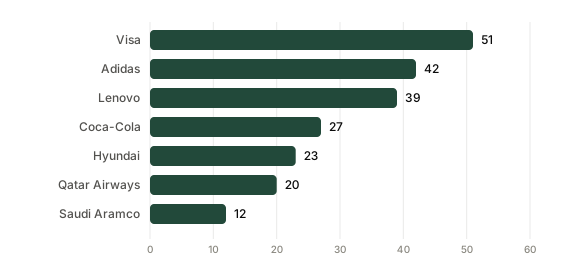
All seven FIFA World Cup 2026 Partners scored 0–100 on public climate evidence. Visa tops at 51, Saudi Aramco scores 12. Open methodology, no offsets counted.
Restaurants have a hygiene rating in the window. Companies have nothing like it for climate — so we built one.
SINK scores companies 0–100 using only their own public records: how much they pollute, what they've promised to change, and the evidence behind both. Same checklist for every company. Results published whether they engage or not. Nobody can pay for a better score. The full methodology is open — you can check the working on every number below.
Tonight, seven companies hold FIFA Partner status — the top sponsorship tier, logos on every board at the most-watched sporting event on Earth1. Here is their rating in the window:
| Rank | Company | Score | Band |
|---|---|---|---|
| 1 | Visa | 51 | Making progress |
| 2 | Adidas | 42 | Below expectations |
| 3 | Lenovo | 39 | Below expectations |
| 4 | Coca-Cola | 27 | Significant gaps |
| 5 | Hyundai2 | 23 | Significant gaps |
| 6 | Qatar Airways | 20 | Significant gaps |
| 7 | Saudi Aramco | 12 | Critical concern |
Average: 31/100.3 Nobody reaches the top half of the scale.
Three things this table tells you
1. The winner isn't a climate leader — it just pollutes less by accident. Visa tops the table at 51 largely because moving money produces far less pollution than moving cars, planes, or oil. That's the business model, not a green strategy. A 51 leads this table and still doesn't clear the top half of the scale.
2. What companies don't publish counts against them — because it should. These scores measure public evidence. Qatar Airways scores 20 not necessarily because of what it does, but because of how little it proves. From the outside, undisclosed and undone look identical — and a rating that gave credit for silence would be worthless. If any of these companies has better evidence, there's a process for submitting it. The score changes when the evidence does. Neither type of payment changes a score.
3. The bottom of the table is simple arithmetic. Saudi Aramco scores 12. Not because we dislike oil companies, but because our formula ties scores to total real-world emissions, counts no offsets, and Aramco is the world's largest corporate greenhouse gas emitter — around 1.8 billion tonnes of CO₂e a year including the burning of its products, more than any country except China, the US and India.4 Aramco's own reporting covers a fraction of that: 72.6 million tonnes, its operational emissions only.5 Any rater using public math gets a number like this. Raters using private math don't publish this table next to a sponsor's logo — which is why you haven't seen it before.
Why this matters beyond tonight
Companies grade their own climate homework, or pay raters who mark it in private. That's the system. A public standard — same questions, same math, results in the window — is the alternative, and this table is what it produces on its first big night out.
Every score above links to a full ten-question breakdown with sources. Explore all 548 scored companies at sinkproject.com.
Scores produced April–June 2026 under SINK methodology v2; these are the live published scores on each company page. Every company is rescored on the same review cycle whether or not it appears in an article.
- 1. FIFA Partner roster: inside.fifa.com/tournament-organisation/partners
- 2. Scored as Hyundai Motor Company, the listed parent of the Hyundai-Kia FIFA partnership.
- 3. Mean of the seven published scores (214 ÷ 7 = 30.6, rounded).
- 4. InfluenceMap, Carbon Majors (2023 data): Saudi Aramco 1,839 MtCO₂e, 4.38% of global CO₂ emissions.
- 5. Aramco reporting, 2023: 72.6 MtCO₂e operational (Scope 1 and 2).
Buy from companies like these? Check your whole supplier list in 48 hours.
Every supplier scored from public evidence and ranked, with the five to follow up first. No questionnaires. From £495.
Related posts
We Scored the Whole FTSE 100 on Climate. It's Not Cutting It.
We scored every FTSE 100 company on public evidence: same ten questions, no questionnaire, no fee. Average 39 out of 100. They measure their carbon well. Very few are cutting it.
We Scored Every UK University on Climate. Here's What We Found.
We assessed all 147 UK universities on public evidence only — no questionnaire, no fee. 66 met our evidence bar and are published with full scores. The other 81 carry the reason instead of a number. Top score: 60 out of 100.
We remade the Premier League table for sustainability
We scored all 20 Premier League clubs on publicly available environmental evidence — same ten questions we ask every company. Five clubs publish figures you can check. Fifteen don't.