Dunelm sustainability score: 46/100
Dunelm is a UK homewares retailer selling furniture, soft furnishings, bedding, and homeware. Founded in 2003 and headquartered in Syston, it operates a chain of stores nationwide.
More about Dunelm
Revenue of £1.8bn (FY26) with ~12,281 employees. It sells own-brand and third-party products across soft goods and hard home categories.
Founded 2003Head office Syston, United KingdomStaff ~12,281 (2026)Revenue £1,825.5M revenue (FY2026, 52 weeks ended 27 June 2026)Website ↗
Dunelm reports declining operational emissions but Scope 3 remains 32% above its FY19 baseline with four years to its 2030 SBTi target. Cotton and timber sourcing show progress but lack third-party verification. Water footprint in the textile supply chain is unmeasured. Circular economy targets are set but delivery is unproven.
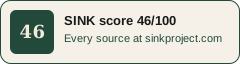
Dunelm scores 46/100 (Making progress) on SINK's independent climate assessment, scored from public data only. Scores are free. Companies can never pay for anything about their own score. Last verified November 2026.
That places Dunelm joint 256th of 934 companies scored, and joint 7th of 50 in Retail (non-fashion).
What is Dunelm doing well, and where does it fall short?
Strongest on Targets & Commitments and Controversies & Red Flags (8/10, 8/10). Weakest on Water Impact and Emissions Trajectory (3/10, 4/10).
Where Dunelm lost points
For each question that lost points, the evidence our public rubric looks for that we didn't find.
- Emissions from its own operations7/10Its own emissions aren't independently verified or tracked over several years.
- Emissions from its supply chain7/10No full value-chain map or supplier engagement programme.
- Whether its emissions are falling4/10No evidence of a year-on-year fall in its total emissions.
- How clean its energy is6/10Less than 90% of its energy shown to be renewable.
- Its effect on nature4/10Its effect on nature isn't measured or independently verified.
- How it uses materials and handles waste6/10No verified figures for reuse and recycling across the business.
- Its effect on water3/10No monitoring of water use, or no measures to reduce it.
- Its climate targets8/10No validated long-term net zero target.
- How openly it reports7/10No annual impact report, or no pay linked to climate targets.
A score changes when the evidence does. We use new published evidence at the next rescore. Anyone can send us new evidence, free. How to send it.
How is Dunelm's SINK score calculated?
Same ten questions for every company. No private weighting.
SINK = (0.3 × Base + 0.7 × Performance) × ScaleWhat evidence is Dunelm's score based on?
12 sources used in this assessment. All publicly available. Each row shows which of the ten questions it informed.
25% of them were published by Dunelm itself; the rest come from independent sources.
9 of 12 sources are independent of the company.
“8,694 tCOe in FY26, 31% reduction versus FY19 baseline”
“In FY26, we reduced them by 31%, driven in part by our gas-boiler replacement programme”
“By 2030, 30% reduction in aggregate water footprint in own brand textiles.”
“Achieved 84 percent Tier 1 supplier Higg FEM completion in FY25”
“Dunelm said in a statement that it is already exceeding its intensity-based emissions goals for Scope 1 (direct) emissions.”
“Moreover, approximately 99.7% of the energy used in the last financial year was sourced from renewables.”
“Dunelm is stepping up its commitment to renewable energy as it prepares to install 2,642 solar panels across its retail and business portfolios.”
“Currently, 39% of timber meets our responsible sourcing requirements”
“Dunelm does not have an adequate Timber Sourcing Policy.”
“committed to reducing its absolute Scope 1, 2 and 3 greenhouse gas emissions by 50% before 2030, as well as 90% by 2040”
“Dunelm has become the first UK-based home textiles retailer to have its net-zero science-based targets validated by the Science Based Targets initiative (SBTi).”
“overall target - reach net-zero greenhouse gas emissions across the value chain by 2040”
If you believe a source has been misread or a newer version exists, submit a challenge.
Is this your company? Claim this profile (free)
Use this score in tenders
Send the link, or the one-page score sheet. It links back to this page and every source. Free.
Open the score sheet →Send new evidence, free
Scored low because little is published? Publish what you do and send us the link, free. If it holds up, your score changes, and the change is logged on your page.
How to send evidence →Put your score on your website, free
It shows the current score and links to this page, so it changes when the score does.
Track this score
Bidding for a public contract? Check if you need a Carbon Reduction Plan, free →
Want your own page like this?
Free, independent, every source shown. Send it to any buyer who asks about your sustainability.
How does Dunelm compare with other retail (non-fashion) companies?
Where Dunelm sits among retail (non-fashion) peers.
Among the 50 major retail (non-fashion) brands we've scored, Dunelm is tied =7th of 50, with 2 others.
Who scores higher in Retail (non-fashion)?
The 3 companies in the sector scoring nearest above Dunelm.
Co-op has delivered measurable absolute emissions cuts across Scope 1+2 (59%) and met climate targets early, backed by SBTi validation.
See the breakdown →Decathlon's total footprint has fallen for four years, to 7.95 MtCO2e in 2025, 16% below 2021, against SBTi-validated net-zero targets.
See the breakdown →B&Q reports strong operational decarbonization (66% since 2016/17) and near-complete renewable electricity (99%), but Scope 3 emissions—99.5% of its footprint—rose 6% last year despite intensity gains.
See the breakdown →Which companies moved this week, and why.
One email, every Sunday. Score changes, new research, the stories behind the numbers. Free.
We'll send one email to confirm. No spam. Unsubscribe in one click.
Checking a company?
Search free →Asked to prove you're sustainable?
Get your business scored, free →Been scored?
Find your page and claim it, free →Scores are free. Companies can never pay for anything about their own score.