We scored your trip to see The Odyssey
Every company that gets The Odyssey to your sofa out-scores every company that gets you into a seat: home streaming averages 46, cinema 30.
Christopher Nolan shot The Odyssey entirely on IMAX film cameras, the first feature ever made that way. It has taken over $400 million in its first ten days, and Nolan has been clear about how it should be watched: on the biggest screen you can find.
Buying a cinema ticket feels like buying one thing. In reality you're buying half a dozen companies' environmental records at once: the chain that owns the seat, the company that built the screen, the bottler that filled your drink. So we scored them, alongside the companies that would put the same film in your living room.
Home
| Company | Score | |
|---|---|---|
| The telly | Sky | 64 |
| The other streamer | Netflix | 41 |
| The streamer it lands on | Warner Bros. Discovery | 34 |
Cinema
| Company | Score | |
|---|---|---|
| The drink | Coca-Cola Europacific Partners | 48 |
| The screen | IMAX | 32 |
| Your ticket | AMC (owns Odeon) | 27 |
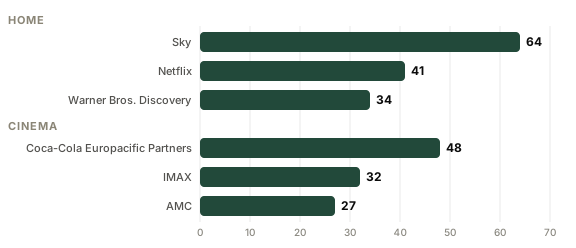
Every company that gets this film to your sofa out-scores every company that gets you into a seat. The companies directly delivering the cinema experience average 30; the companies delivering the film to your telly average 46. Not one cinema-facing company reaches 50, and the one that comes closest is the drink.
The pattern isn't that any single company is bad.
It's that the closer a business sits to the physical experience, the less it can tell you about its environmental footprint.
The ticket: nothing to assess
AMC is the world's largest cinema chain, over 900 theatres, including the entire Odeon estate in the UK and Europe. It discloses no Scope 1, 2 or 3 emissions, no climate targets, no trajectory, no renewable strategy, no sustainability report. For a company running hundreds of large climate-controlled buildings on three continents, there is effectively no public climate disclosure to assess. Its 27 rests mostly on the absence of controversy.
The UK's other major IMAX operator, Cineworld, we could not score at all: since its 2023 restructuring took it private, we could not assemble enough verifiable public evidence to meet our standard. Everyman came one source short of our minimum; we stopped rather than lower the bar. Millions of tickets will be sold this month by companies whose environmental record cannot be independently assessed.
The screen: last reported 2021
IMAX is around 700 people who design projection systems, license them to cinemas, and take a share of the box office. Its own footprint is genuinely small, but small is not the same as managed. Its last global sustainability report dates to 2021, with no emissions figures, no targets, and almost nothing on the outsourced supply chain where an equipment company's real impact lives.
Demand for the format is not the problem: IMAX took $51.8 million worldwide from just 444 screens in the film's opening weekend, with 70mm venues running 3am screenings to meet it. The disclosure is the problem.
The drink: the multiplex's best disclosure
The Coke at the concession stand comes from Coca-Cola Europacific Partners, the bottler, a different company from the Atlanta brand owner we score at 27. CCEP has SBTi-validated targets across all three scopes, third-party assured data, and absolute emissions 13.6% below its 2019 baseline. Also a French greenwashing complaint and corrected recycling claims, both priced in. Its 48 is a middling score anywhere else. At the cinema, it's the strongest environmental record in the building.
Home: where disclosure is normal
The Odyssey will eventually stream on HBO Max, operated by Warner Bros. Discovery: 34, with rising emissions and no third-party verification, the weakest of the home options, and still ahead of every cinema company. Netflix scores 41. And Sky, whose box sits under the telly you'd watch either on, scores 64: SBTi-validated targets, third-party assured emissions data, and a 40% absolute reduction since 2018, the strongest disclosure record on this table.
The public evidence suggests broadcasters and streamers have faced sustained pressure to disclose, and responded. The exhibition sector has not, or if it has, it hasn't responded where anyone can see.
The number nobody reports
One more thing, and it's the biggest number in the room: your journey. Industry research puts transport at half of a typical film production's footprint, and for cinema-going, audience travel dwarfs the building's own emissions. It appears in nobody's disclosure, not AMC's, not IMAX's, and not our scores either, the same way we don't charge a supermarket for your drive to it. If you walk to the cinema, you've personally out-performed the exhibition industry's entire climate reporting. That isn't a high bar. There isn't any.
The gap
See the film. It was made for the big screen, and by all accounts it's extraordinary.
For two decades, cinemas have sold the premium physical experience, bigger screens, better sound, formats with their own trademarks. The industry has faced far less public pressure to explain that experience's physical footprint than broadcasters and streamers have, and it shows in the record: the world's largest chain publishes nothing we can assess, the format's owner last reported in 2021, and the UK's second-biggest operator can't be independently scored at all.
Christopher Nolan pushed filmmaking technology further than anyone before him. The companies selling that experience have not shown the same ambition in explaining their environmental impact. That's the gap these scores reveal.
All SINK scores are reproducible from public sources. Each company page lists the evidence used and which of the ten questions it informed. Think we've misread something, or you're Cineworld with eight sources to show us? Challenge it. Every challenge is published.
Related posts
We Scored the Whole FTSE 100 on Climate. It's Not Cutting It.
We scored every FTSE 100 company on public evidence: same ten questions, no questionnaire, no fee. Average 39 out of 100. They measure their carbon well. Very few are cutting it.
We Scored Every UK University on Climate. Here's What We Found.
We assessed all 147 UK universities on public evidence only, no questionnaire, no fee. 66 met our evidence bar and are published with full scores. The other 81 carry the reason instead of a number. Top score: 60 out of 100.
We remade the Premier League table for sustainability
We scored all 20 Premier League clubs on publicly available environmental evidence, same ten questions we ask every company. Five clubs publish figures you can check. Fifteen don't.
Asked to prove your business is sustainable?
Get an independent score you can send. Free, with no forms. Ready in 2 working days.
- Filling in a tender?Add an independent score to the sustainability section, with a link the buyer can check.
- Customer sent a sustainability questionnaire?Send your score sheet with your answers. It links to your full score page, with every source.
- Asked for your green credentials?Reply with a link to your score page. It shows what you do and where the evidence came from.