Eleven of Europe's 20 Biggest Airlines Have Been Caught Greenwashing. We Scored All of Them.
Courts, the ASA and the European Commission have all ruled against European airlines' green claims. We scored the twenty biggest on their public data. Top score: 35 out of 100. Every source shown.
We set out to score Europe's twenty largest airline groups on their public sustainability data — the same rubric we apply to every company on SINK. We expected to spend our time in annual reports and emissions tables.
We spent a lot of it reading court judgments.
Eleven of the twenty have had an environmental claim ruled unlawful by a court, banned by an advertising regulator, or dropped under pressure from the European Commission. That isn't our claim about them. It's their own regulators' claim, and the regulators won.
The nine that haven't: Turkish Airlines, Pegasus, TUI, Jet2, Aegean, ITA Airways, LOT, Air Europa and Icelandair. In several cases, that's because they disclose so little there was nothing to challenge.
The table
| # | Airline group | SINK score |
|---|---|---|
| 1 | Finnair | 35 |
| 2 | Wizz Air | 33 |
| 3= | Icelandair | 32 |
| 3= | Virgin Atlantic† | 32 |
| 5 | SAS | 31 |
| 6 | Jet2 | 30 |
| 7= | Pegasus | 29 |
| 7= | TUI | 29 |
| 9 | easyJet | 28 |
| 10= | Air France-KLM | 27 |
| 10= | Aegean | 27 |
| 10= | Lufthansa Group | 27 |
| 10= | TAP Air Portugal | 27 |
| 14= | Ryanair | 26 |
| 14= | Turkish Airlines | 26 |
| 14= | Norwegian | 26 |
| 14= | Air Europa | 26 |
| 18 | IAG (British Airways, Iberia, Vueling, Aer Lingus) | 25 |
| 19 | ITA Airways | 23 |
| 20 | LOT Polish Airlines | 22 |
The top score is 35 out of 100. Not one airline reached "Making progress," our middle band.
Before you assume we're grading on a curve: flying is one of the most carbon-intensive things a person can do, and our scores begin from the physical impact of the business, not the quality of its reporting. No airline can score well. The point of the table isn't the ceiling — it's the thirteen-point spread underneath it, and what's actually in the evidence.
†Not in the top 20 by passengers; included because UK readers would ask. Aeroflot excluded — sanctions have collapsed its disclosure. All scored on methodology v2.5, verified 12 July 2026. Every source is on the company's page. Neither type of payment changes a score.
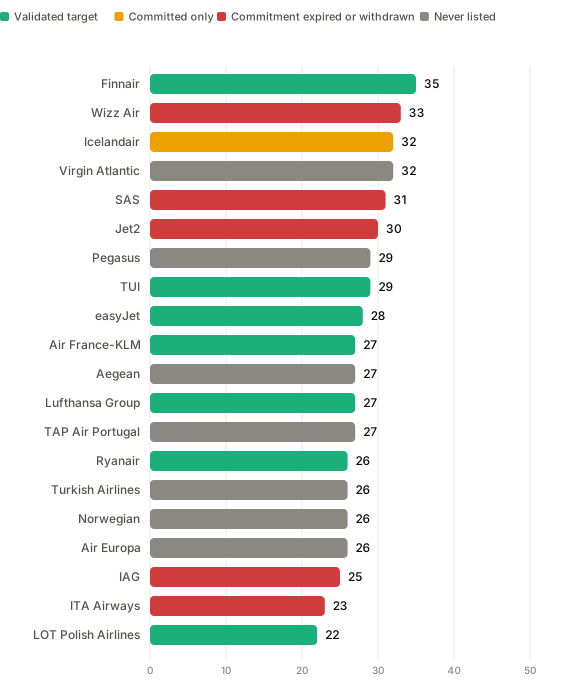
The colours are the second story. Red means the airline made a science-based climate commitment and no longer holds it. Note where the red sits: not at the bottom of the table, but scattered right through the top half.
What the regulators found
In March 2024, the District Court of Amsterdam ruled that 15 of 19 environmental claims in KLM's "Fly Responsibly" campaign were misleading and unlawful — the first successful greenwashing judgment against an airline anywhere. The court was specific: suggesting that a compensation product "actually reduces, absorbs or compensates" a flight's climate impact is not true, and telling customers otherwise breaks the law.
In March 2025, a Cologne court ruled that Lufthansa could no longer advertise its Green Fares with the promise that customers were offsetting their flight's emissions through climate projects. The court's reasoning: the wording suggests to the consumer that he can make his flight climate-neutral with a cash payment, "which is indisputably not true." That judgment is not yet final — Lufthansa said it would review it. But the group has already lost the same argument on appeal: in late 2024, the Cologne Higher Regional Court ruled against Eurowings, a Lufthansa Group airline, over its CO2-compensation advertising.
The UK's Advertising Standards Authority has banned adverts from Wizz Air ("one of the greenest choices in air travel" — no basis given, upheld November 2024), Virgin Atlantic (its Flight100 "100% sustainable aviation fuel" radio ad — banned August 2024) and Ryanair ("Europe's lowest emissions airline" — withdrawn February 2020, after the ASA found the supporting chart was from 2011).
Finnair — top of our table — was pulled up by Finland's Consumer Ombudsman for marketing that gave a misleading impression about its fuel: the advertising implied a scale of sustainable-fuel use that the actual figure, a fraction of a percent, did not support. Finnair agreed to stop.
And in November 2025, the European Commission announced that 21 airlines had committed to stop claiming a flight's CO2 can be neutralised or offset by paying extra. Ten of the twenty groups in our table are on that list — Air France-KLM, Lufthansa, easyJet, Finnair, Norwegian, Ryanair, SAS, TAP, Wizz Air, and Vueling inside IAG. The Commission published a table tracking who has actually fixed what. It notes easyJet has only partly resolved its net-zero claims, and Lufthansa Group still has four commitments outstanding.
The quiet lapses
Here's a finding sitting in a public spreadsheet that nobody seems to read.
The Science Based Targets initiative publishes a dashboard of every company with a validated or committed climate target. We checked all twenty groups against it on 12 July 2026.
Five of the twenty groups made a commitment and no longer hold it. IAG, SAS, ITA Airways and Wizz Air let theirs expire — the SBTi removes a commitment when a company fails to submit targets for validation within 24 months. Iberia, inside IAG, expired separately.
And Jet2 didn't let its lapse. Jet2 withdrew.
Of the 31 airlines on the SBTi dashboard anywhere in the world, Jet2 is the only one whose commitment is marked withdrawn. Every other removal, in every other country, is an expiry. Jet2 committed in May 2024 and pulled out. There was no announcement. It's in the dashboard data.
Seven groups do hold a validated near-term target, and they deserve the credit: Ryanair, Air France-KLM, Finnair and LOT's parent company are validated against the 1.5°C pathway; Lufthansa, easyJet and TUI are validated to the weaker "well below 2°C" standard.
But look at what happened to their net-zero pledges. Lufthansa and easyJet each hold a validated near-term target — and each has had its net-zero commitment removed for expiry. So has IAG. So has SAS.
Near-term targets, the ones with a deadline inside a current executive's tenure, get validated. The 2050 promises quietly lapse.
The Ryanair paradox
Ryanair sits mid-table at 26, which will irritate everybody.
Ryanair has among the lowest emissions per passenger of any major airline — full aircraft and a young fleet. It holds a validated science-based target. It also carries more passengers than any airline in Europe and keeps adding aircraft, so its total emissions keep climbing.
Both things are true, and the gap between them is the single most useful thing to understand about airline climate marketing. Efficiency per passenger and total emissions are different numbers, and in this sector they routinely move in opposite directions. The atmosphere only counts totals.
That's why the ASA's problem with Ryanair's "lowest emissions airline" advert wasn't that the number was fake. It was that the comparison wasn't substantiated and the basis wasn't clear. Efficient is not the same as low-impact when you're growing.
Five of the twenty — Pegasus, Aegean, ITA, Air Europa and LOT — don't disclose absolute emissions at all. We didn't estimate the gap. It is the finding, and it's why they sit where they sit.
What separates 35 from 22
Three things, and not one of them is a pledge.
SAF money, not SAF words. EU and UK mandates now require a minimum blend, so using sustainable aviation fuel is compliance, not leadership. What scored was signed offtakes, equity in production, actual tonnes burned.
Fleet. A new-generation aircraft burns 15–20% less fuel than the one it replaces. Unglamorous capital expenditure is the most real decarbonisation in aviation. Wizz Air ranks second largely on the strength of one of the newest fleets in the sky, which is what makes its banned advert so unnecessary. The fleet was the story. The marketing wasn't needed.
Publishing the number that's going up. The airlines near the top tell you their total emissions rose. The ones near the bottom make you dig for it, or never publish it.
What to do with this
If you're flying this summer, the flight is the impact and the airline is second-order. Fly direct where you can.
Skip the offset box at checkout. Courts in two countries, the UK's advertising regulator and the European Commission have now all said the same thing about those schemes. And several airlines in this table have already stopped offsetting their own emissions, putting the money into fuel and fleet instead. They're right to. If the airlines don't believe the offset works, you shouldn't either.
And then do the thing nobody does: look up your airline. Every score above links to a page showing exactly how it was calculated, question by question, with every source cited and clickable. Disagree with a score? The methodology is public and every score is open to challenge.
We're not asking you to take our word for it. We're asking you to check.
All twenty groups scored on SINK methodology v2.5, verified 12 July 2026, including a check of each against the SBTi target dashboard (dashboard update of 9 July 2026). Neither type of payment changes a score.
Buy from companies like these? Check your whole supplier list in 48 hours.
Every supplier scored from public evidence and ranked, with the five to follow up first. No questionnaires. From £495.
Related posts
We Scored the Whole FTSE 100 on Climate. It's Not Cutting It.
We scored every FTSE 100 company on public evidence: same ten questions, no questionnaire, no fee. Average 39 out of 100. They measure their carbon well. Very few are cutting it.
We Scored Every UK University on Climate. Here's What We Found.
We assessed all 147 UK universities on public evidence only — no questionnaire, no fee. 66 met our evidence bar and are published with full scores. The other 81 carry the reason instead of a number. Top score: 60 out of 100.
We remade the Premier League table for sustainability
We scored all 20 Premier League clubs on publicly available environmental evidence — same ten questions we ask every company. Five clubs publish figures you can check. Fifteen don't.